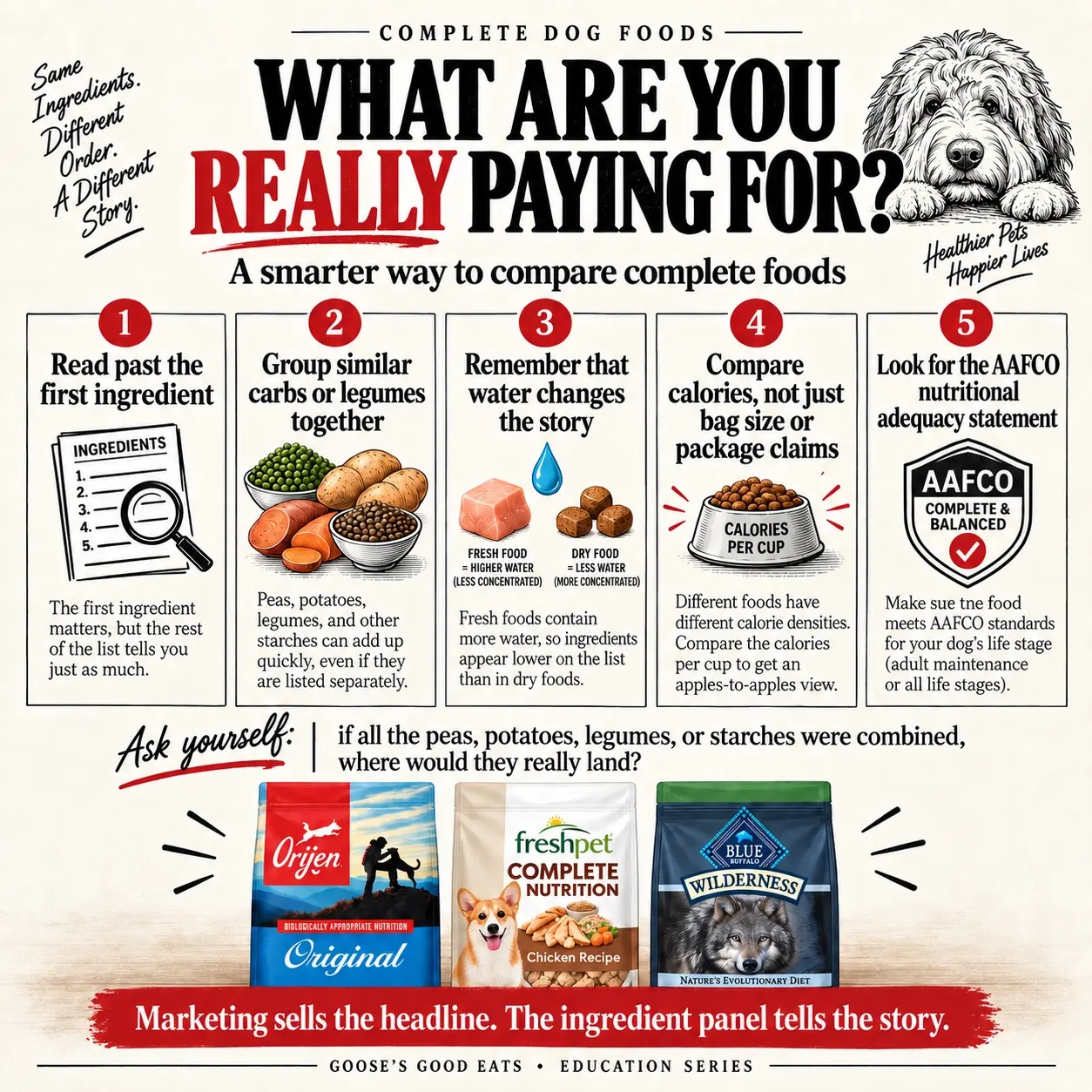
A package can truthfully lead with “real chicken” and still leave a shopper with important questions. The useful skill is not finding one magic word. It is learning how the different parts of the label fit together.
We believe recognizable, minimally processed food deserves a serious place in the bowl. We also believe label education has to be precise. An ingredient list can reveal patterns; it cannot reveal every ingredient’s percentage or prove why a company divided one ingredient family into several names.
First, know what the list can—and cannot—tell you
Under U.S. labeling rules, ingredients are listed individually in descending order by weight as they are added to the formula. That weight includes naturally occurring water. The list tells you sequence, but AAFCO notes that it does not quantify the absolute amount of each ingredient.
So “chicken is first” does not mean the finished food is more than 50% chicken. Likewise, seeing peas, lentils, and chickpeas in several positions does not tell us their combined percentage. It gives us a reason to look more closely—not a license to invent a number.
What people mean by “ingredient splitting”
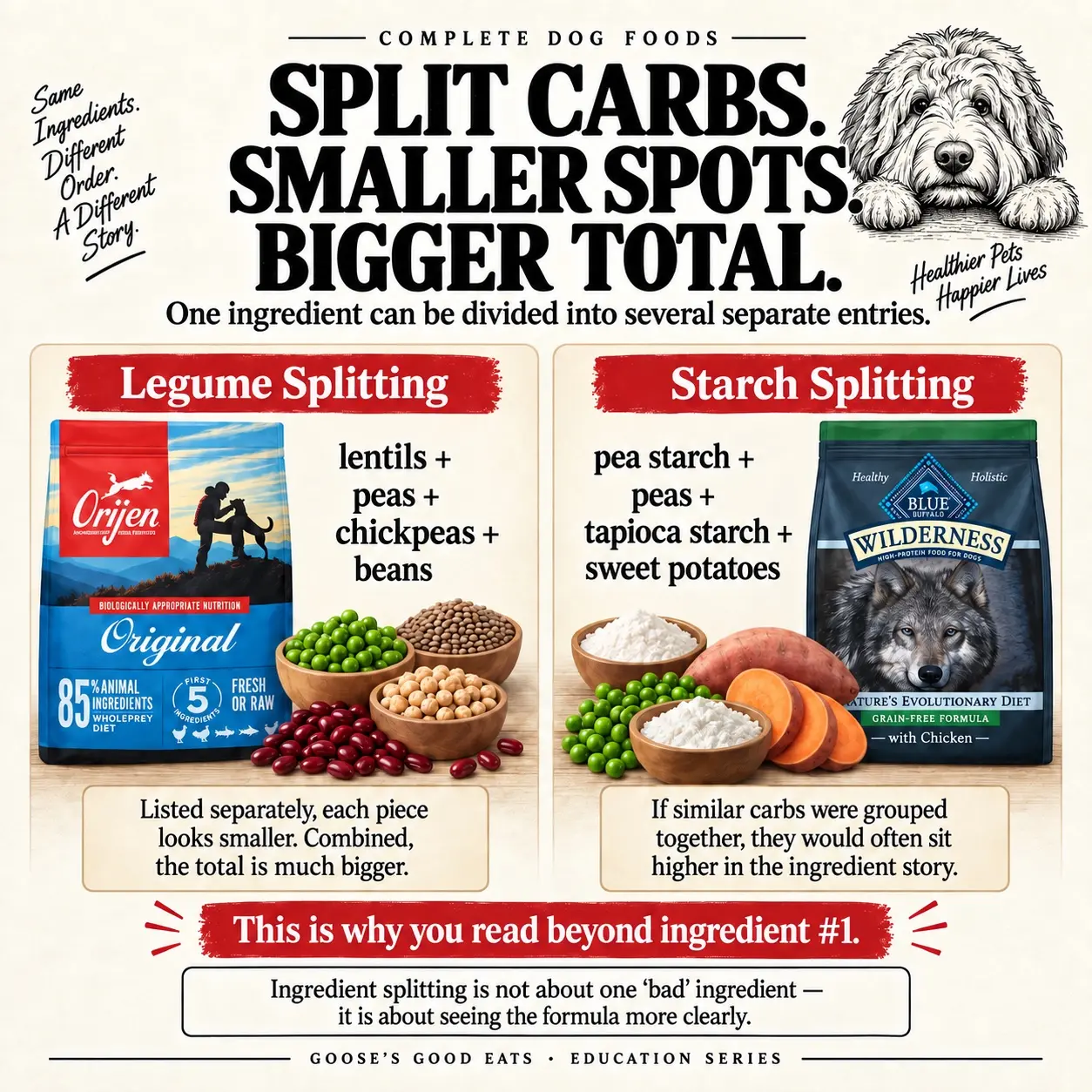
In consumer label analysis, ingredient splitting describes a formula that lists closely related ingredients separately—such as peas, pea protein, and pea starch, or several different legumes. Because each item occupies its own position, no single line shows the family’s combined weight.
That observation can be useful. It can help you notice whether multiple starch or legume ingredients cluster near the top of the panel. But it should be framed as a question, not a verdict: How much of the formula might this ingredient family represent, and what nutritional jobs is it doing?
Four real labels, four different stories
These examples are not a best-to-worst ranking. They show why the same reading method produces a more nuanced conclusion for different kinds of food. Formulas and labels can change; the details below were checked against the manufacturers’ current pages on September 9, 2026.
Coast & Coop
Chicken with bone · chicken heart · chicken liver · whole sardines · blueberries · carrots · spinach · oysters
A short, animal-forward ingredient deck with whole sardines and no added water named on the list. We do not claim an exact meat percentage here because the public ingredient panel does not provide one.
Freshpet Complete Nutrition
Chicken · chicken broth · brown rice · rice bran · carrots · ground oats · carrageenan · natural flavors · peas
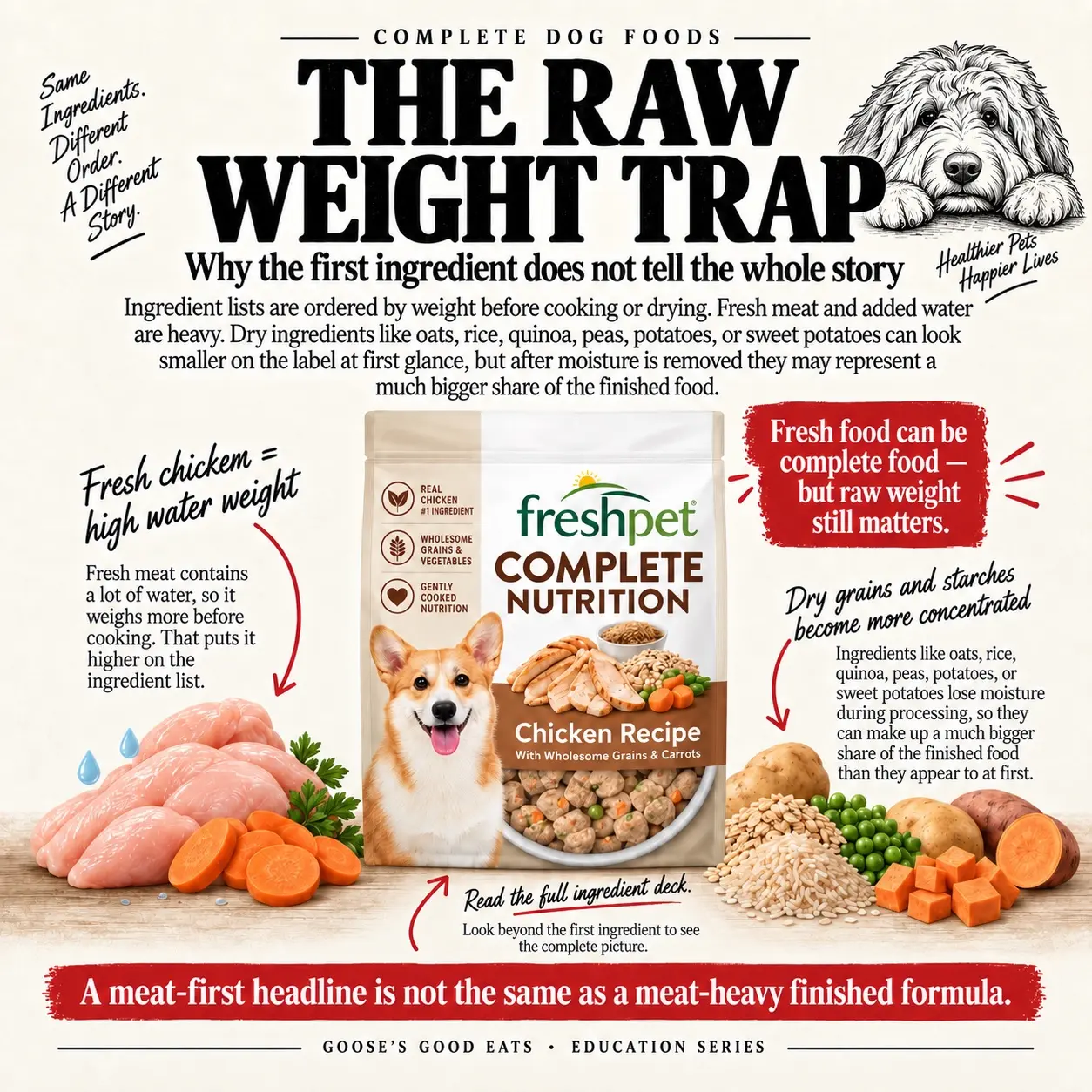
Chicken is first, but its raw weight includes water and the finished food is 78% moisture maximum. Brown rice, rice bran, and oats show why it is worth reading beyond position one.
Merrick Chicken & Sweet Potato
Deboned chicken · chicken meal · turkey meal · sweet potatoes · potatoes · peas · chicken fat
Three named animal ingredients lead the current formula; three starch or legume ingredients follow. Merrick also states that 81% of the recipe’s protein comes from animal sources—a useful disclosure the ingredient order alone cannot supply.
ORIJEN Original
Chicken · turkey · salmon · whole herring · chicken liver · dehydrated animal ingredients · red lentils · beans · chickpeas · peas
Several legumes appear, but only after a long run of fresh, raw, and dehydrated animal ingredients. ORIJEN says the recipe contains 85% animal ingredients in its unprocessed state. That context matters.
What this comparison shows: Counting plant names is not enough, and celebrating one first ingredient is not enough. Look at the sequence, the form of the ingredients, the company’s quantitative disclosures, the guaranteed analysis, and the food’s intended job.
The raw-weight and moisture effect
Fresh meat and many vegetables arrive with substantial water. Meals and dehydrated ingredients have already lost much of that moisture. Because ingredient order is based on as-added weight, a fresh meat may begin high on the list and contribute less dry matter after processing. That does not make fresh meat undesirable—it simply explains why position one cannot stand alone as a composition claim.
Guaranteed analysis: useful, but still not the whole formula
The guaranteed analysis gives minimum crude protein and fat, maximum crude fiber and moisture, plus any other required or voluntarily guaranteed nutrients. These are legal guarantees, not a complete nutrient profile, and protein or fat may test higher than its stated minimum.
Most importantly, these percentages are shown as fed. A food with 78% moisture and a dry food with 11% moisture should not be compared by simply placing their protein percentages side by side. Dry-matter conversion can normalize the moisture difference, but it still does not tell you protein quality, amino-acid balance, digestibility, or ingredient sourcing.
Same columns. Very different moisture.
| Food | Protein min | Fat min | Fiber max | Moisture max |
|---|---|---|---|---|
| Coast & Coop | 14% | 8.5% | 2.5% | 71.5% |
| Freshpet roll | 7.5% | 7% | 1.5% | 78% |
| Merrick dry | 32% | 16% | 3.5% | 11% |
| ORIJEN dry | 38% | 18% | 4% | 12% |
Coast & Coop values come directly from its current package: crude protein 14% minimum, crude fat 8.5% minimum, crude fiber 2.5% maximum, and moisture 71.5% maximum. All values remain as-fed guarantees; the table does not convert them to dry matter.
Calories per ounce make portions easier to compare
Calorie density does not tell you whether a food is “better.” It tells you how much energy is packed into its weight—and why equal-looking scoops can feed very differently. This is especially useful when comparing a moist frozen food with dry kibble or when replacing part of a base food with a topper.
Approximate calories per ounce
Manufacturer calorie statements converted from kcal/kg or kcal/cup where necessary. Rounding shown. This is a portioning comparison, not a quality score.
A five-step label-reading routine
- 01Find the adequacy statement.
If the food will be the whole meal, confirm that it is complete and balanced for your dog’s life stage. “Topper,” “intermittent,” and “supplemental” products have different jobs.
- 02Read past ingredient number one.
Note the first several ingredients, their forms, and which ones supply protein, fat, starch, fiber, and micronutrients.
- 03Notice ingredient families.
Mentally group related starches or legumes to see the pattern—but do not claim a combined percentage the manufacturer has not disclosed.
- 04Pair the list with the guaranteed analysis.
Moisture changes how as-fed percentages look. Dry-matter math can normalize water, but it cannot measure ingredient quality.
- 05Check calories and feed the dog in front of you.
Use kcal per ounce or cup to portion accurately, then watch body condition, digestion, energy, and any veterinary needs.
Where Coast & Coop fits
Coast & Coop is our frozen, complete-and-balanced adult-maintenance recipe built around chicken with bone, organs, and whole sardines, followed by purposeful whole-food ingredients. At about 38.5 kcal per ounce, it occupies the same energy-density neighborhood as the Freshpet roll in this comparison, even though their ingredient stories are quite different.
That is exactly why we do not want customers choosing from one number or one front-label phrase. Calories answer how much energy? The adequacy statement answers complete for whom? Ingredients answer made from what? The guaranteed analysis gives several nutrient guardrails. You need all four.
The takeaway
The first ingredient is a clue, not a conclusion. Read the whole sequence. Notice repeated ingredient families without pretending to know undisclosed percentages. Put moisture beside the guaranteed analysis. Compare calories in a common unit. Confirm the food’s intended use and life stage. Then consider processing, sourcing, and the individual dog.
That approach leaves room for a food-first point of view without turning label reading into a gotcha. It is more honest, more useful, and much harder for a beautiful front panel to distract.
This independent educational article uses brand names, label excerpts, and limited product imagery for identification, analysis, and commentary. All trademarks and packaging belong to their respective owners. Goose’s Good Eats is not affiliated with or endorsed by the compared brands. Formulas can change; always confirm the current package.